
Drilling Deep
The Kaskida Project and the Power of Student Inquiry
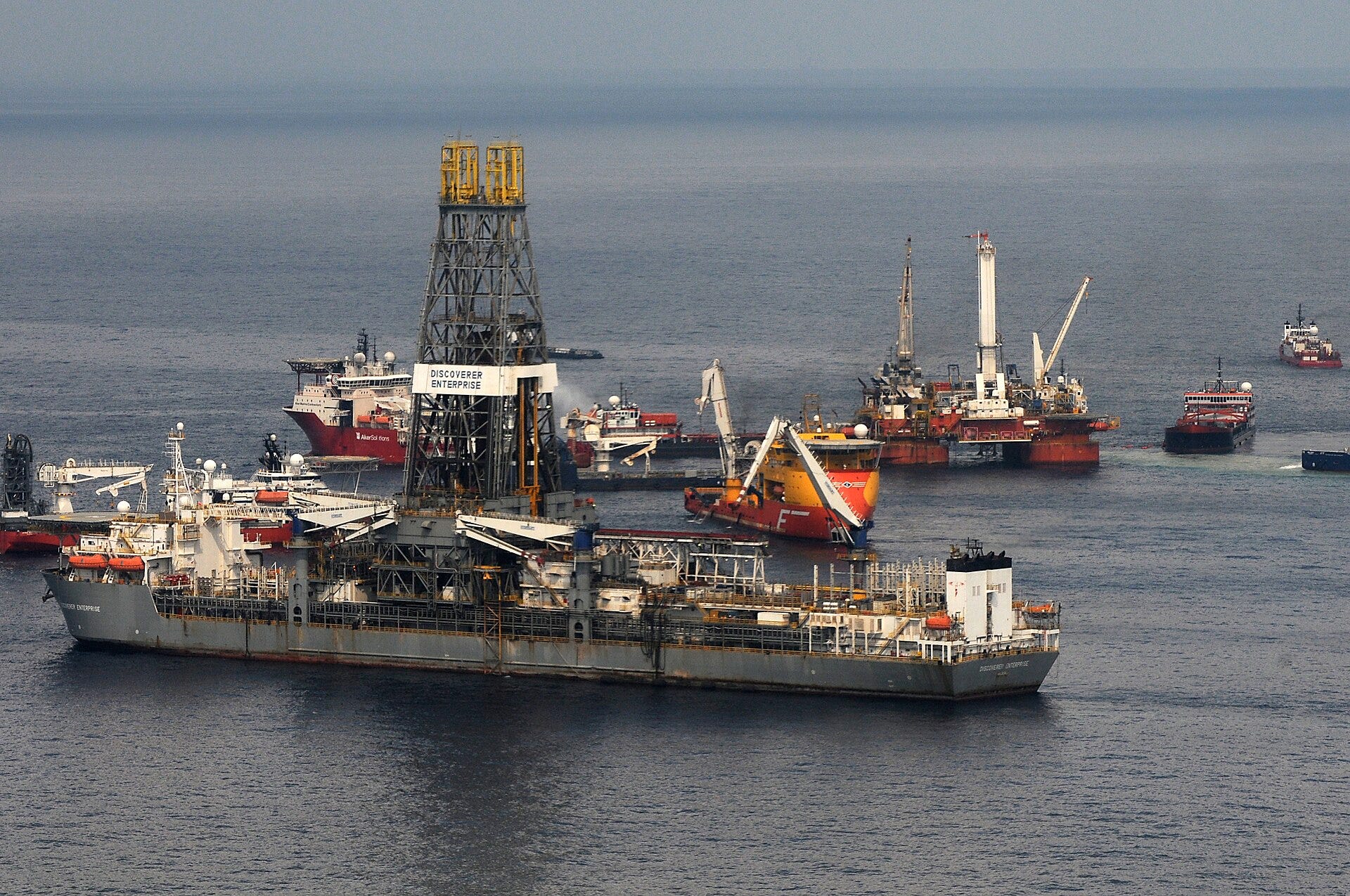
The mobile offshore drilling unit Q4000 holds position directly over the damaged Deepwater Horizon blowout preventer as crews work to plug the wellhead using a technique known as “top kill,”. The procedure was unsuccessful in its intention to stem the flow of oil and gas and ultimately kill the well by injecting heavy drilling fluids through the blow out preventer on the seabed down into the well. The en:Discoverer Enterprise is in the foreground. (U.S. Coast Guard photo by Petty Officer 3rd Class Patrick Kelley.)
We recently marked the 16th anniversary of the Deepwater Horizon oil spill, a sobering reminder of both the promise and peril of modern energy systems. Now, according to reports, BP has received federal approval for a new offshore drilling project known as Kaskida in the Gulf of Mexico, a project that may push the boundaries of engineering even further than before.
At the proposed site, a massive floating platform will operate in waters over a mile deep. From there, the well will extend roughly 32,500 feet beneath the ocean floor, nearly three miles deeper than the Deepwater Horizon well. Conditions at that depth are extreme: temperatures approaching 370°F and pressures around 20,000 psi. Extracting oil safely under such conditions is not just difficult; it is a profound technological challenge.
And for educators, it is also a remarkable opportunity.
This is the kind of topic that invites curiosity, demands critical thinking, and naturally lends itself to Project-Based Learning. It is not simply about oil drilling. It is about systems, tradeoffs, risk, innovation, and responsibility.
Below are several PBL project pathways that secondary students could pursue.
Project 1: Engineering the Impossible
Driving Question: How can engineers safely extract oil from extreme environments like the Kaskida site?
Students investigate the science and engineering behind deep-sea drilling. They examine materials, pressure systems, thermal dynamics, and fail-safe mechanisms. Teams could design and test small-scale models that simulate pressure conditions or propose innovations to improve safety.
NGSS Connections:
• HS-PS3-1: Energy and matter interactions
• HS-ETS1-2: Design solutions to complex real-world problems
• HS-ESS2-2: Earth systems and geoscience processes
Project 2: Risk, Responsibility, and Regulation
Driving Question: How should society balance energy needs with environmental protection?
Students explore the regulatory landscape surrounding offshore drilling. They analyze past disasters, including Deepwater Horizon, and evaluate current policies. Teams could simulate a public hearing, with students representing industry leaders, environmental scientists, policymakers, and local communities.
NGSS Connections:
• HS-ESS3-4: Evaluate or refine technological solutions that reduce human impact
• HS-ETS1-3: Evaluate solutions based on constraints and trade-offs
Project 3: The Economics of Energy
Driving Question: Is deep-sea oil extraction economically and socially sustainable?
Students investigate the financial aspects of projects like Kaskida. What does it cost? Who benefits? What are the long-term risks? They compare fossil fuel investments with renewable energy alternatives and present recommendations based on economic and environmental data.
NGSS Connections:
• HS-ESS3-1: Natural resource distribution
• HS-ETS1-1: Analyze global challenges and resource limitations
Project 4: Environmental Impact and Ecosystems
Driving Question: What are the potential ecological consequences of deep-sea drilling?
Students study marine ecosystems in the Gulf of Mexico and assess how drilling operations—and potential spills—could affect biodiversity. They may model oil dispersion, examine food webs, or propose mitigation strategies.
NGSS Connections:
• HS-LS2-6: Evaluate claims about ecosystem interactions
• HS-ESS3-3: Create computational models to illustrate environmental impacts
Project 5: Civic Action and Public Awareness
Driving Question: How can citizens influence decisions about large-scale energy projects?
Students move from analysis to action. They research the Kaskida project, develop informed positions, and create public-facing products—op-eds, presentations, policy briefs, or community forums. The goal is not to tell students what to think, but to help them learn how to think, communicate, and participate.
NGSS Connections:
• HS-ESS3-4: Evaluate solutions for reducing human impacts
• Science and Engineering Practice: Engaging in argument from evidence
A Final Thought
Projects like Kaskida sit at the intersection of science, technology, economics, and ethics. They are complex, consequential, and very much alive in the world our students are inheriting.
This is where Project-Based Learning finds its natural home.
Not in abstraction, but in the careful study of real challenges. Not in passive reception, but in active investigation. Not in simple answers, but in thoughtful questions.
If we want students to grow into informed, capable citizens, we must give them opportunities to wrestle with issues like this, guided by good teaching, grounded in evidence, and oriented toward meaningful purpose.
That is work worth doing.